
Size Guide
Understanding Mylulusstore Sizing


Description
xModel: Jean d’Eve “Sectora” Automatic
Year: December 2003
Features:
The Popularity. Double retrograde hour and minute hands aren’t an uncommon sight these days - whether it be a legendary Lotec No. 6 from Japan, a punchily-priced Vacheron Constantin, or a Kickstarter-created Xeric, the retrograde complication’s popularity has surged in recent years.
The Pioneer. But Jean d’Eve beat them all to market, and even received a patent for their troubles. To be clear, they didn’t invent the retrograde complication as that honour supposedly belongs to German watchmaker, Hans Buschmann, in 1650, but Jean d’Eve’s impact on the modern market cannot be ignored.
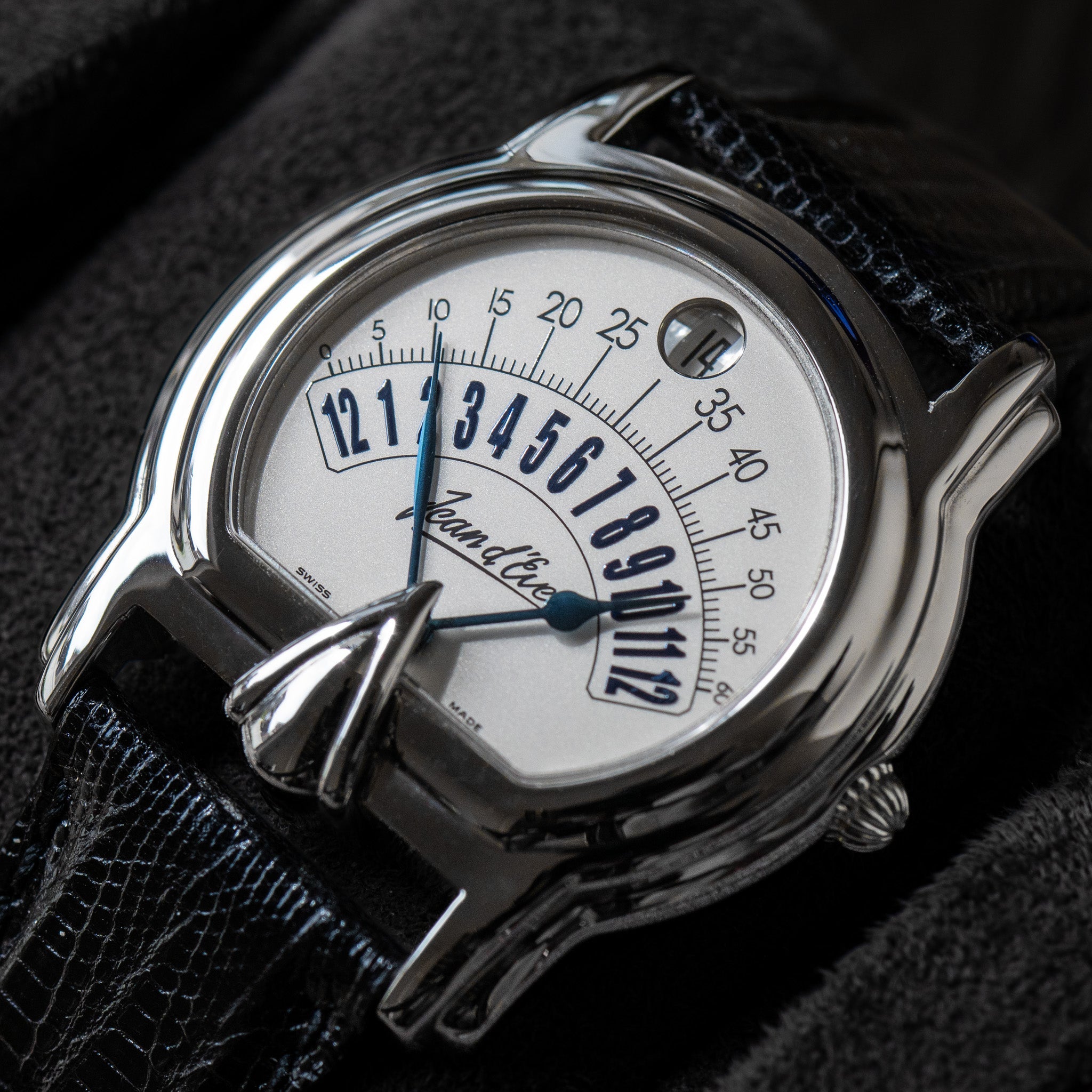
The Movement. Released in 1989, the Sectora retrograde watch was the result of modular design. Rather than developing a wholly in-house movement, the team at Jean d’Eve aimed for a more universal approach, and created a retrograde module that could sit atop an existing movement. Originally launched as module for quartz movements, Jean d’Eve successfully tweaked it to be compatible with automatic watches, and with that breakthrough came the launch Automatic Sectora II - the watch on offer today.
The Module. By adding a retrograde module to an ETA, Jean d’Eve gained agility. They could deploy the complication across different case shapes, sizes, and price points - something that would have been prohibitively expensive if done in-house. More recently, Lotec and Xeric reached the same conclusion, with both opting to use a Miyota as their base movement.
The Design. Design-wise, the case shape and ridged bezel echo the shell motifs commonly seen in Art Deco. The unusual form lends itself perfectly to the double retrograde dial layout. The flower petal that wraps around the bottom of the case, designed to hide the pinion on which the hands sit, only adds to the immediately recognisable Jean d’Eve look.
Specifications:
Condition: In great condition overall. Some swirls and hairlines may be visible on the case, but there are no marks of any significance.
Scope: Full box and papers. On the original strap and clasp.
Movement: Heavily Modified ETA 2892A2 with 28,800bph
Dimensions:
- Case Width: 37.5mm
- Lug to lug: 41.0mm
- Case Thickness: 9.2mm
- Lug Width: 19mm


- Choosing a selection results in a full page refresh.